A door that opens on its own has three causes. We work through all three in sequence.
A door that opens with no input is not a mystery, it is one of three things. Radio interference reaching the opener receiver, a remote with a shorting button that keeps transmitting, or a logic board issuing commands that nobody sent.
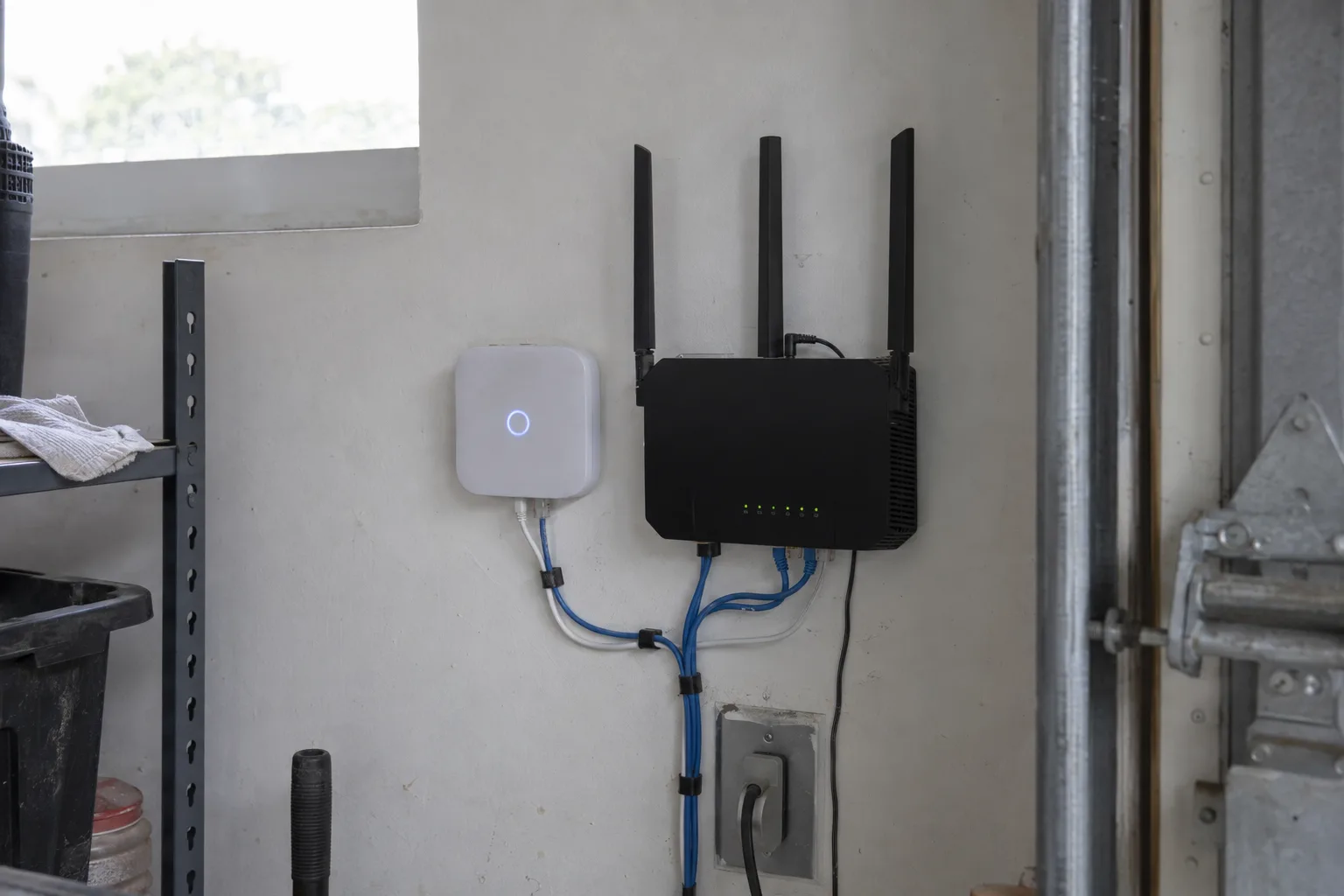
Each is confirmed differently. Interference means checking the receiver against nearby devices: smart home hubs, cameras, and LED fixtures with switching power supplies are the usual suspects. A remote short is found by clearing the opener memory and reintroducing devices one at a time. A board fault is confirmed by testing behaviour and voltage after the first two are ruled out.
Nothing gets swapped until one of the three is confirmed, because replacing a board that was never faulty leaves you with the same door and a bill. This runs under opener repair.
Density of connected devices is the honest explanation. A property with a hub, cameras, an irrigation controller, LED retrofits and several remotes has more sources of stray signal than a house from twenty years ago, and older receivers are less selective than current ones.
Distance plays a part too. On large lots with detached garages, remotes get carried further and used at the edge of their range, and a button in a pocket or a car console is pressed far more often than anyone realises.
None of that is a reason to live with it. A door opening on its own is an open house, and it is fixable once the source is identified rather than guessed at.
In this order every time, because each step rules out the one before.
The receiver is checked against known interference sources in and around the garage before any hardware is touched.
The opener memory is cleared so no stored device can trigger it, which also removes any remote a previous owner or contractor still holds.
Each remote, keypad and vehicle button is reintroduced and tested on its own, which is how a shorting button is caught.
If the first three are clean, the logic board is tested for erratic behaviour, voltage inconsistency and heat damage.
Ten consecutive open and close cycles with every device reconnected before the job is closed.
A door that opens on its own is a security problem, so the rest of the security gets a look.
If the opener predates rolling codes, replacing it is the fix. A fixed-code receiver can be triggered by a device that was never yours, and modern units are covered by the standards published by DASMA, the industry standards body.
Call (689) 407-8963Windermere, FL 34786
Primary service zone, Orange County. Not sure whether you are inside the radius? Call (689) 407-8963 and ask.
On an old fixed-code opener, yes, it was possible. Modern units use a rolling code that changes with every press, which is one reason a very old opener is worth replacing rather than repairing.
It happens. A button pressed by a bag or a coat in the console transmits exactly like an intentional press. Clearing the memory and reintroducing devices one at a time is how that gets caught.
Some do. LED fixtures with switching power supplies can emit interference in the same band the receiver listens on, and garage-mounted retrofits are the usual offender because they sit close to the antenna.
Yes, and that is the point. Every device is reprogrammed afterwards, which also removes any remote you no longer have in your possession.
It is a security problem. The door being open at three in the morning is the risk, and it is why this gets treated as urgent rather than as a curiosity.
Ten consecutive cycles with all devices reconnected, plus the cause identified rather than a part swapped hopefully.
Give us the symptom and a number. We will call you back, usually within the same working day. For a door that will not close, call (689) 407-8963 instead.
Licensed Florida contractor #93-2002026. Serving Windermere 34786 and the west Orlando corridor. 24/7 emergency dispatch.